

032. New Year, New Screen Limits - For Me.
Working on breaking my own phone habits to model for my child

I started writing this post in January, but lo and behold, we’re already in March! I guess it’s still kind of a New Year because Lunar New Year just passed a few weeks ago…right? :)
Before the end of 2025, I posted a picture of a slide that I snapped at a youth mental health presentation I attended last spring that went a bit “viral.” While the presentation talked about why kids should delay getting smart phones or social media, this particular slide stood out to me because it’s not enough just to tell our kids they can’t have these things if we’re not also recognizing what impact tech is having on us —the parents who are trying to model healthy screen habits.
The slide shows post-it notes of quotes that a child clinical psychologist jotted down—things her child clients told her on how they feel about their parents on their phones.
And it absolutely broke my heart.
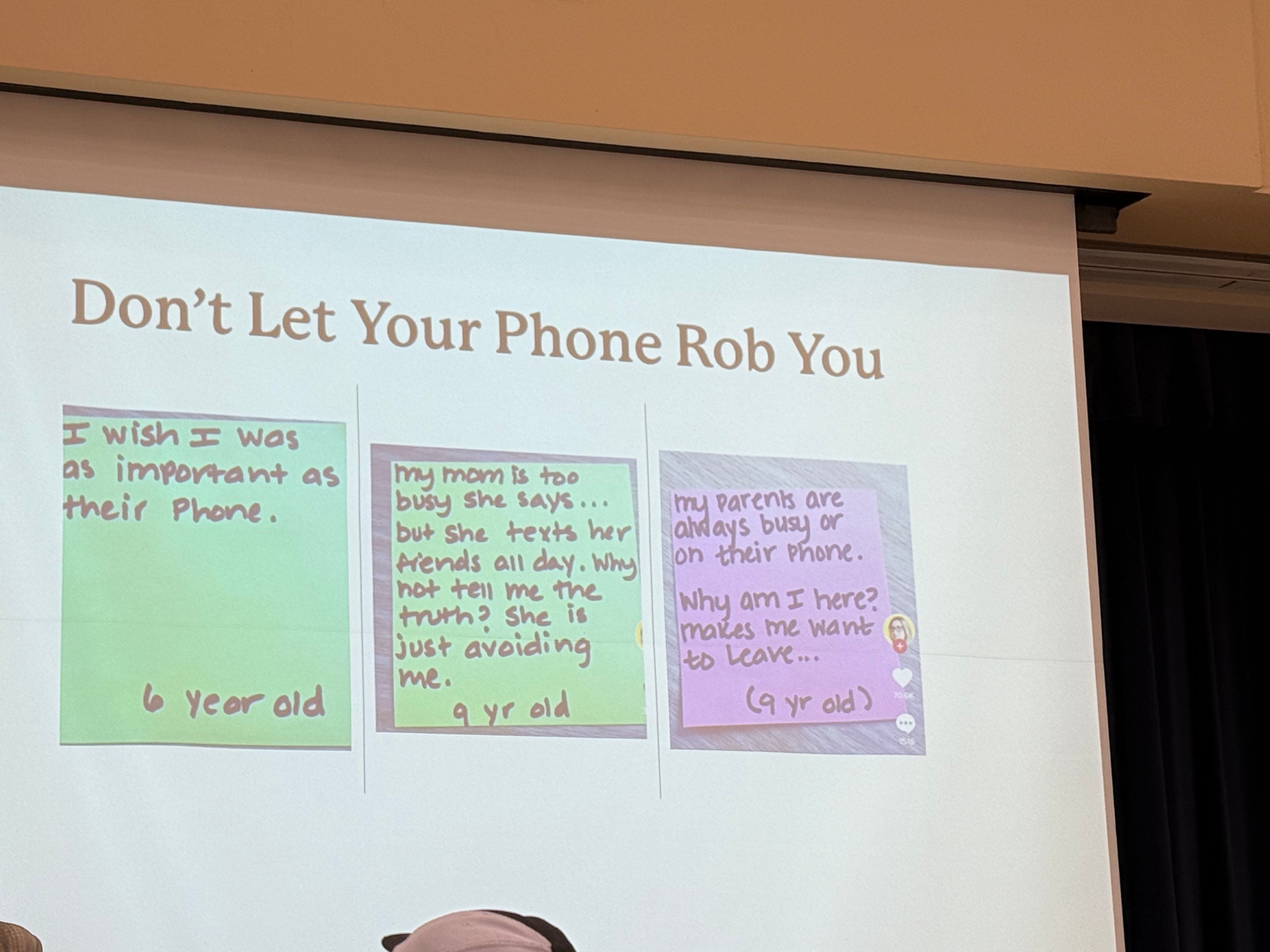
Apparently, it also broke a lot of other people’s hearts because my Instagram post of this quick snap has surprisingly and swiftly become my most liked, saved, shared, viewed post EVER in almost 9 years—nearly 1 million views. 😳🤯 (That’s a lot for little ol’ me, okay?)
I’m not mentioning this to brag. In fact, I actually hate when my posts go viral because I get a lot of anxiety over everyone messaging, commenting, and following me during that window. It gets overwhelming and I actually prefer being more anonymous. But I mention this to say: this just goes to show that the topic really hit on a lot of nerves, just like it tugged on my own heartstrings.
Furthermore, it also reinforced my goals for this year to be intentionally mindful of my own screen time use, which also trickles down into improving my overall mental health too. This newsletter today will go over my goals for the year and how I hope to get there, as well as the things I have already tried and how they went.
I had also originally posted this picture to promote our Healing the Tigress subscriber podcast episode talking about our own screen habits with my perinatal therapist cohost. So this is a really small plug here, and yes—it’s for paid subscribers (it’s only $5 though!). But Peggy and I do a LOT of free work, so this is one small area we try to get some supporters to help us with some fees we regularly pay to keep the lights on, so to speak. 🙏🏼 If you’ve supported us through subscribing, we sincerely thank you!
But beyond this small plug, I truly am passionate about working on protecting my kid’s mental health in relationship to screen usage as she grows older, and I do think that I can’t enforce these things around her without taking a good hard look at myself and my own habits. So here we are.
If you’re wondering where to start and feel overwhelmed, you’re not alone. I’ve felt this way too, but I’ve been chipping at it for a long time. Even though I’ve been trying for awhile, it has still been very hard for me to put my intentions into lasting actions as well. But I hope maybe today’s newsletter can give you some inspiration or ideas, and I’ll tell you with open honesty where I really failed too and how I’m trying to tackle my habits with other approaches.
I don’t believe in perfection, but I do believe in persistently trying and showing up. Thanks for being here if you are, and read on for more!

Breaking Bad (Screen Habits)
I think what is important to remember is that as Jonathan Haidt, author of The Anxious Generation, describes: smart phones and apps are intentionally designed with the psychology and science of addictive slot machines in mind—it’s basically attention economy. So if it feels hard to set limits around your phone or put it away and not scroll, IT’S NOT YOUR FAULT. It’s because the makers of these products literally hacked our brain psychology to make phones and apps enticing, addictive, and habit-forming. That was their job.
So the key is really to think about how to form new habits and break old ones. The brain will always want to take the path of least resistance to get a reward, hence making you subconsciously form the habit without even realizing it. I found it fascinating when Charles Duhigg and Dr. Becky talked on her podcast in January about how habits are formed. He mentions habits are a series of neural connections that flow in this order: cue, routine, reward. And that to break the habit, it’s a better idea to focus on the cue and the reward to disrupt the routine. Check out the podcast episode here.
On the topic of breaking habits, around the end of 2025, Peggy (my co-host) sent me an Instagram post that cited a method that a Finnish teacher invented, claiming to remove phone addiction in 10 days…! You may have seen similar posts circulating with this method, and I thought it couldn’t hurt to try it because I think it was trying to disrupt the cues and hopefully lead to a better reward of time back in the real world. Basically it goes like this:
Before picking up your phone, say out loud why you’re doing it.
Pause and count to 10 when you reach for the phone before unlocking it. If you can wait, you’re in control; and if you can’t, it’s a sign of dysregulation. Work on increasing the pause.
Rule on Day 5: No phone in your hand. No phone on your desk. Distance yourself and don’t have it readily visible.
Rule on Day 7: Don’t bring the phone with you. (Room to room, to the bathroom, to the stairs, to fill up empty transition moments.) When you stop filling transitions with your phone, your mind wakes up to look around.
By Day 10, they found the number of phone unlocks for kids and adults dropped 52-65% since the first day.
I’ve tried looking for the original source of this method and this Finnish teacher and Finnish studies they quote, but it’s hard to find amongst a sea of social media posts re-posting and re-quoting it. If anyone knows of the real source, please do let me know!

Trying and Failing and Trying Again
So I tried the above! And honestly, for the month of January, I actually did quite well and surprised even myself. It was during this month that we took a trip to Yosemite with our pre-school friends and being able to disconnect in nature was another phenomenal way of starting the year fresh with renewed purpose and wonder. I also read more books, including Maya Shankar’s new book The Other Side of Change (highly recommend!!), so I wasn’t on my phone as much because I was so engrossed in my readings.
I didn’t count exactly what day I was on or follow the 5 or 7 days rules, but I started with just saying to myself why I was picking up my phone, and even that alone made me stop and re-consider if I really needed to unlock it or open up something. Because I knew that inevitably, when I opened up social media or my emails or texts, I would see myself get sucked into checking another notification or start scrolling.
Being intentional about why I was going to reach for the phone helped me try to turn it back into a tool instead of something I instinctively and randomly grabbed for. My average screen time report dropped by over an hour per day! That’s over 7 hours back of my life each week! I felt like I was more productive at work and around the house and truly just had more energy to actually get stuff done.
One trick I started to do was every time I felt tempted to open up my social media app for no true legitimate reason (like podcast publishing, messaging a guest, etc.), I forced myself to open my Notes app first and edit my To Do List. This would end up making me pause and consider what actually was important to be done in the moment. I would also be thinking ahead to jot down what else I could be doing—and then go do that instead.
And of course, sometimes the reason was that I did just want a break to scroll and catch up a bit with my friends’ lives. That’s fine, too! I allowed myself those moments. BUT, I noticed that changing the scroll page to looking only at the people I was following was helpful instead of getting just random ads and targeted news to make my heart rate go up. I tried to be intentional about how much time to allot for this.
But I will be honest, I failed in February.
I fell back to a habit of wanting to reach for my phone to check or post on social media starting in early February mainly because of two things:
I went to a Backstreet Boys concert at the Sphere and wanted to document this big milestone for myself—flying for the first time alone in 12 years and a mom’s only trip?! Hallelujah!
The Winter Olympics with AAPI and female winners were too exciting (and I didn’t have real time streaming so I caught up on social media).

Not excuses; just life. So I went a little backwards in my goals, and I concede that I am not perfect and only human! The effects were noticeable though. My tension headaches that had been basically non-existent anymore started returning by the end of February. And that makes so much sense because average adult heads are like 11-pound bowling balls, but when you lean forward that increases closer to a 20-lb weight. When you are constantly looking down, your neck is trying to support that bowling ball all the time. This tracks since I noticed my headaches always started at the base of my skull.
But starting this month, my goal is to try a little harder with the Finnish teacher method above and continue to be better at limiting reaching for my phone for mindless scrolls, especially when my kid is around. I used to think I could just phone scroll when she wasn’t nearby, but I realized that I actually need to just overall stop the habit if I want to be better when she’s nearby. Habits can’t be broken if you’re only doing it half the time!
The thing is we can’t expect to be perfect all the time, but it doesn’t mean we stop trying! And as long as we keep trying, I think that’s truly the best we can do.
Personal Focus Time and Phone Restrictions
Other steps I took to make my device work better for me (iPhone):
Set up Personal Focus Times and Sleep times that automatically turn on at a set schedule, like after work. I can control which important notifications still come through (like my husband’s notifications are never silenced.)
Keep screens away from the meal tables and just focus on the presence of people around. I admit I love a good foodie picture of nice meals, but I am quick about snapping and then putting my phone away!
Go to the Notifications settings and turn off everything that doesn’t serve me. I also minimized notifications on my watch.
I think these are only small hacks that can help facilitate the process, but the true change still lie with reforming habits and asking myself, “why do I need my phone right now?”
The Amazing Generation — a Resource for Kids (& Adults!)
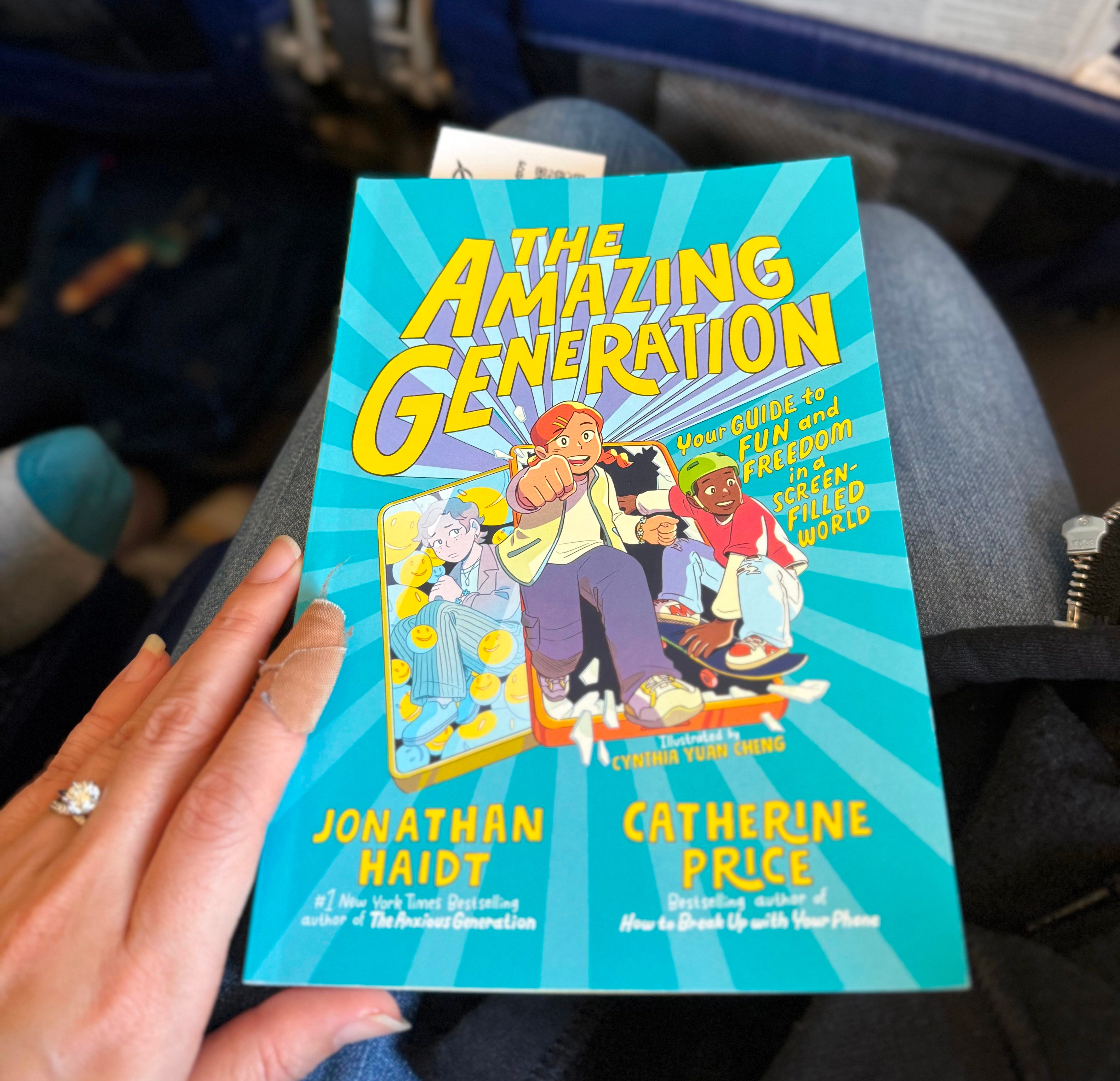
And then there is THIS resource! Back at the end of January, our family took a short weekend trip for a competition and I started and finished Jonathan Haidt and Catherine Price’s new book all on the plane. The book is called The Amazing Generation: Your Guide to Fun and Freedom in a Screen-Filled World. It was such a quick and easy read (I mean, because it was written for tweens!), and I highly recommend even the parents give it a read. I wanted to preview it and know the contents so that one day I could let my daughter read it too and have some language to talk to her about these topics.
If you haven’t already heard of it, this book is really easy to read because it’s written in partial graphic-novel along with many infographics and a storyline of describing the secrets of the “tech wizards” and what they’re really trying to do to make money by capturing our kids’ attentions and collecting information on them to advertise to them. It teaches them the psychology behind rewards, addiction, brain rot, targeted ads, etc. so kids are aware of the strategic way screens and apps are designed. And it gives them ideas and tools on how to reclaim their lives as “Rebels” and maybe choose for themselves to hold off on social media or smart phones. I’ll insert some pictures of some of the content of the book for you to preview here (click to enlarge):


I also love the real life testimonials from Gen Z teens and young adults who admit they wish they didn’t waste so much of their youth and give it away to their phones. Tweens would easily be able to read it, AND, if you’re too anxious to read The Anxious Generation or your spouse is like mine who doesn’t love reading, give this book a try because it’s an easier-to-digest version! My husband said he would read it!
At the end of the day, I think about why I’m trying to curb my screen habits, and truly, it’s for my daughter. Yes, I benefit too, but I think if it weren’t for her, I might have just caved and called myself a lost cause. I do think some parents have this mentality and just succumb.
However, I grew up in an age where I didn’t have a smart phone, and I know what that’s like to live without one. I’m pretty sure most parents of young children these days can relate as well. I could revert back to it if I really wanted to. But she does not know what that’s like. And I want to try to give her a chance to see that we can live life using our phones as tools and not things that we cannot control our habits over.
I want her to know that in our family, we prioritize people over phones.
So this book is a great tool to start with educating younger kids on what they’re up against, even before they get into that stage! I’m not saying we can’t teach them how to use tech one day, but as Dr. Becky said on a recent podcast episode with both of these authors, “Most people want their kids to be able to swim in an ocean. And nobody starts by teaching your kid how to swim in the ocean.” (I recommend listening to that convo too!)
Just because kids need to learn how to use the tech one day doesn’t mean we have to throw them in before they are developmentally ready. And the years of puberty are extremely critical for brain neuroplasticity and formative rewiring, which is why big tech wants to prey on their attention during these years—addicted upstream customers forever!
But I think there is hope.
If enough parents are also on the same page of raising their kids to delay when they have smart phones and social media til after peak puberty years, I think our kids will have an easier time not being the outliers. I do sense a movement already happening with this as people get landlines (us!), revert to basic flip phones, limit social media, etc.
And as Jonathan Haidt says, if we are trying to reduce screen time, we have to replace it with other better experiences. For myself, as I try to cut back, I know I have to replace my own screen time with other things—writing, reading, spending time with my husband, family board games, biking, etc. But I truly felt happier when I was cutting down and finding more time and energy for things in real life and looking up instead of down. 🙃
If you’ve read this far, I appreciate you, as always! ❤️ Let me know if you have any good tricks or tips that work for you because I’m always open to learning from others who have found success. If I’m successful…maybe you’ll see me churn out more newsletters this year as I reclaim more time to write! 🙃
You shared such valuable tips on how to break from being tied to our phones. I often use my phone as a clock because my watch battery died, or as a way to check my steps to see how many steps I get in, and then it get sucked in my social media and it becomes such a distraction. Seeing those post it notes is heartbreaking but such a necessary reminder. thank you for being vulnerable in sharing this.